Advanced Security for Banking Integrations with SAP Integration Suite
An executive overview of how SAP Integration Suite can be extended to meet advanced banking security requirements using mTLS, JWS digital signing, JWE encryption, and defense-in-depth patterns.
 6 min read
Banking API integrations are among the most demanding scenarios in modern enterprise architecture. It is not enough to connect systems, transform messages, or expose services. In these contexts, security must be designed as a core capability of the solution.
At Centraal Studio, we approach these challenges from an integral perspective: architecture, integration, security, operations, and maintainability. Our goal is not only to make an API respond correctly, but to build solutions prepared for corporate environments where confidentiality, traceability, and technical compliance are essential.
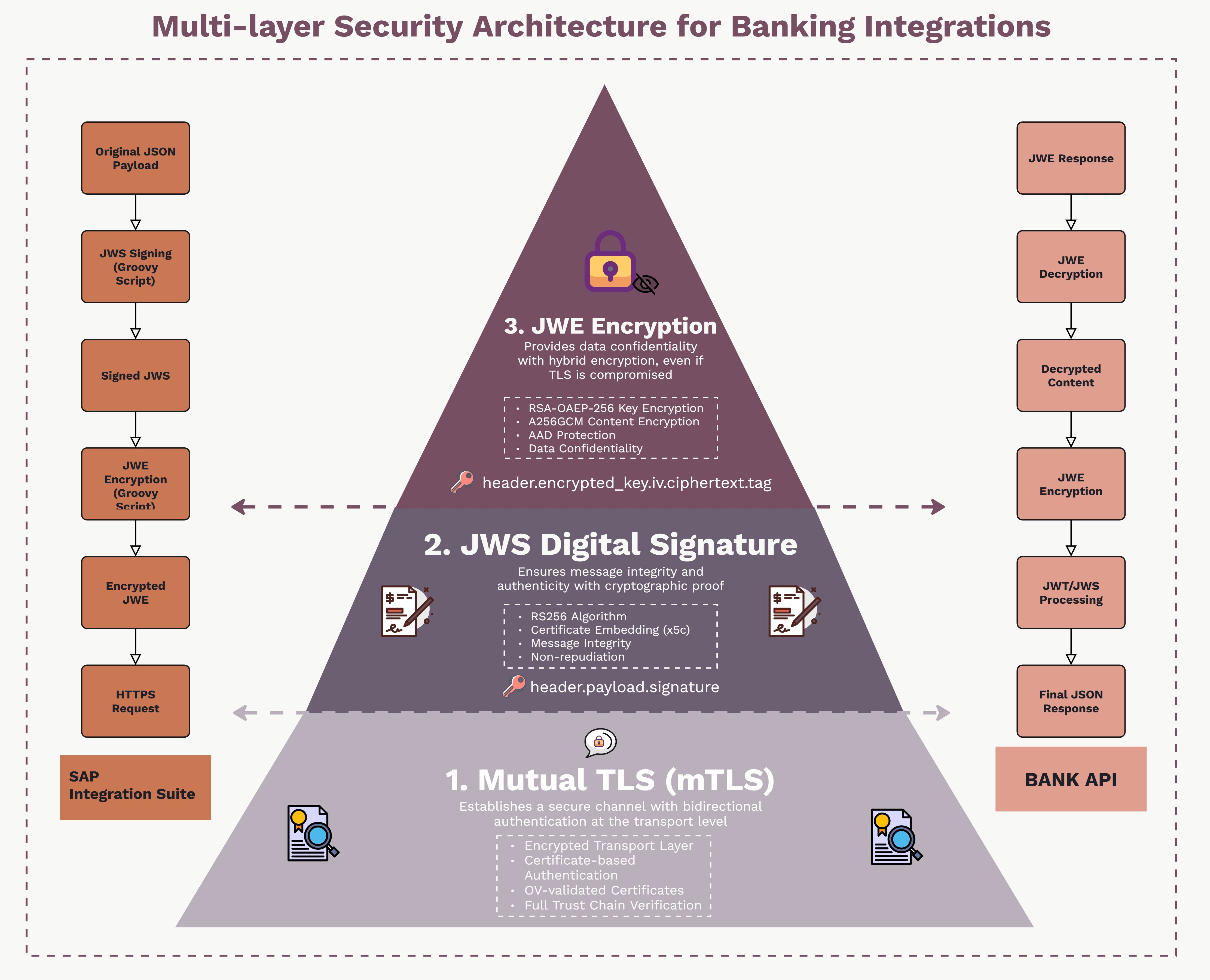
I recently published a technical article on SAP Community about an advanced banking security implementation with SAP Integration Suite, using mTLS, JWS, JWE, and the Nimbus JOSE+JWT library.
This article summarizes the approach from an executive and architectural perspective. The full technical details are available on SAP Community.
The Challenge: Banking Security Beyond Traditional Authentication
Financial institutions often require security mechanisms that go beyond common authentication patterns such as username and password, API keys, or bearer tokens.
In many scenarios, a modern banking integration must combine several protection layers, including:
- Mutual authentication through digital certificates.
- Digital message signing.
- Encryption of transmitted content.
- Certificate separation by purpose.
- Trust chain validation.
- Secure handling of private keys.
- Compliance with modern cryptographic standards.
This requires the integration architecture to go beyond standard platform configuration and include security from the design stage.
A Defense-in-Depth Architecture
The solution presented in the technical article implements a defense-in-depth approach on SAP Integration Suite.
This means security does not depend on a single layer, but on multiple mechanisms working together to reduce risk.
The architecture is based on three main components:
1. mTLS to Protect the Communication Channel
The first layer is Mutual TLS, also known as mTLS.
This mechanism allows both the client and the bank to validate their identities through digital certificates before establishing communication.
In a banking integration, this is essential because it allows the solution to:
- Validate the identity of the API consumer.
- Prevent service impersonation.
- Establish an encrypted transport-level channel.
- Ensure certificates are part of a valid trust chain.
In many cases, banks also require certificates issued by a certificate authority with organization validation.
2. JWS to Ensure Integrity and Authenticity
The second layer uses JWS, JSON Web Signature.
With JWS, the message is digitally signed before being sent to the bank. This makes it possible to validate that the content was not altered during the process and that it was generated by a trusted source.
This layer provides key capabilities such as:
- Message integrity.
- Sender authenticity.
- Non-repudiation.
- Auditability.
- Use of certificates within the security header.
In practical terms, JWS allows the bank to receive a signed message and cryptographically validate that the content belongs to the authorized sender.
3. JWE to Protect Message Confidentiality
The third layer uses JWE, JSON Web Encryption.
While JWS focuses on signing the message, JWE encrypts it. This protects the confidentiality of the content, even in scenarios where transport-level protection already exists.
With JWE, the message is protected through an encryption scheme that combines asymmetric and symmetric cryptography.
This approach is especially useful in integrations where sensitive data, tokens, financial information, or payloads must be protected end to end.
SAP Integration Suite as an Extensible Foundation
One of the most important lessons from this implementation is that SAP Integration Suite can be extended to support highly specialized security scenarios.
Although the platform provides standard integration capabilities, some banking requirements demand additional logic, especially when working with standards such as JWS and JWE.
In this case, the solution used Groovy scripts together with the Nimbus JOSE+JWT library, allowing the JOSE standards to be handled in a more robust, maintainable, and standards-aligned way.
This approach shows that SAP Integration Suite should not be seen only as a tool for moving messages between systems, but as an enterprise architecture platform capable of adapting to complex scenarios.
Why Use Nimbus JOSE+JWT?
The Nimbus JOSE+JWT library helps simplify the implementation of standards such as JWS and JWE.
Instead of manually developing complex cryptographic operations, Nimbus provides a specialized foundation to handle:
- Digital signing with JWS.
- Encryption and decryption with JWE.
- Algorithms such as RS256, RSA-OAEP-256, and A256GCM.
- JOSE structure validation.
- Reduction of common errors in manual implementations.
This matters because, in security, it is not enough for a solution to work. It must also be correct, maintainable, and aligned with recognized standards.
Business Value
This type of architecture is especially relevant for organizations that need to integrate SAP with banks, fintech platforms, payment processors, financial platforms, or external APIs with strict security requirements.
The main benefits include:
- Better alignment with banking security requirements.
- Reduced risk when exchanging sensitive information.
- Reusable architecture for multiple financial APIs.
- Improved maintainability compared to manual cryptographic implementations.
- Greater technical control over certificates, keys, and payloads.
- Ability to adapt SAP Integration Suite to high-security scenarios.
For technology teams, this approach provides a stronger foundation for future financial integrations.
For the business, it represents greater trust, operational continuity, and the ability to integrate with financial ecosystem players without compromising security.
From a Technical Case to an Enterprise Capability
Although the technical article focuses on an authentication flow, the described patterns can be extended to other banking services that require the same level of protection.
Once the architectural foundation is in place, the same approach can be applied to different scenarios, such as:
- Financial information queries.
- Payment processing.
- Transaction confirmation.
- Treasury integrations.
- Reconciliation services.
- Corporate banking APIs.
The key is to design a reusable, documented architecture that is ready for real operations.
Read the Full Technical Article
This publication presents an executive view of the approach.
The full technical article, including JWT, JWS, and JWE structures, certificate configuration, implementation flow, Groovy scripts, and troubleshooting considerations, is available on SAP Community:
Read the technical article on SAP Communit
Conclusion
Modern banking integrations require a much broader security vision than traditional connectivity.
Combining mTLS, JWS, and JWE enables a multilayer architecture that protects the communication channel, guarantees message integrity, and encrypts transmitted content.
At Centraal Studio, we design enterprise integrations that combine architecture, security, and technical execution. This case reflects our way of working: understanding the business context, designing a solid solution, and bringing it to a maintainable implementation on enterprise cloud platforms.
If your organization needs to integrate SAP with banks, financial APIs, or external services with high security requirements, we can help you design a secure, scalable architecture ready for real operations.
Do You Need to Integrate SAP with Banking APIs or Financial Services?
Schedule a conversation with Centraal Studio and let’s discuss how to design a secure architecture for your integration.
Keep reading

Haceb: SAP-Salesforce integration powers tech service 4.0
We built a SAP-Salesforce integration for Haceb, streamlining their technical service, inventory management, and real-time analytics — lifting operational efficiency and customer satisfaction.

Crystal: Price optimization with advanced analytics
We built an advanced analytics platform for Crystal, automating price benchmarking and raising data quality — powering faster decisions and stronger market competitiveness.
Want something similar?
Schedule a conversation with the Centraal team.